
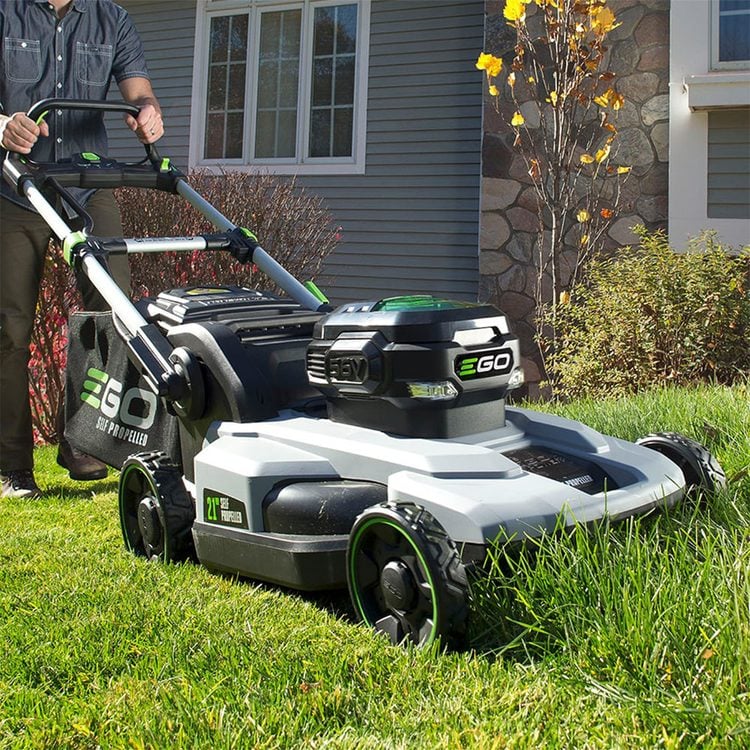
The Saturday-morning mower aisle does not feel the same anymore. The EGO Power Plus 56V Self Propelled Mower sits at the center of that shift because it answers the one question many U.S. homeowners keep asking: can a battery mower replace the gas machine without turning lawn day into a compromise? For a growing number of suburban yards, the answer is yes, but not for the lazy reasons most ads repeat.
This is not only about being quiet. It is about skipping fuel cans, oil stains, pull cords, garage fumes, and that small dread before the first spring cut. For buyers following home tech and product demand, the larger story is clear: battery outdoor tools have crossed from “interesting” to normal. EGO lists features such as up to 80 minutes of runtime with two included 56V 5.0Ah batteries, variable self-propel speed, six cut-height positions, and mulching, bagging, or side discharge on its 21-inch Peak Power model. The point is not that gas is dead. The point is that gas finally has to defend itself.
Why EGO Power Plus Became the Yard-Care Switch Point
Most mower trends fade because they solve one problem while creating another. A lighter mower may bog down. A cheaper mower may feel flimsy by June. A quiet mower may cut poorly once grass gets damp. The reason this brand keeps showing up in buyer talk is more practical: it moved the battery mower from a novelty to something a regular homeowner can picture using every week.
The mower aisle finally made sense to regular homeowners
For years, gas mowers had one hidden advantage: familiarity. You knew the ritual even if you hated it. Fill the tank, check the oil, yank the cord, smell the exhaust, fight through the thick patch near the fence. That routine felt annoying, but known.
Battery mowers had the opposite problem. They sounded cleaner on paper, yet buyers feared weak blades, short runtime, and expensive battery packs. That fear was not foolish. Early cordless models often felt like tools for tiny lawns, not real American yards with slopes, crabgrass, wet clumps, and that one strip along the sidewalk that grows like it has a secret water source.
Ego changed the conversation by making the switch feel less strange. Push-button start matters more than spec-sheet people admit. So does folding storage. So does the lack of a warm engine sitting near bikes, paint cans, and kids’ sports gear in the garage.
A homeowner in Ohio with a third-acre lot does not wake up wanting battery theory. He wants the front yard done before the rain. A parent in Georgia wants to mow after dinner without sounding like a small engine repair shop. The quiet part becomes practical, not polite.
Why the battery platform matters more than peak power
The non-obvious win is not only the mower. It is the battery family. Once a homeowner owns a 56V pack, the next purchase feels easier: blower, string trimmer, hedge trimmer, maybe a snow tool in colder states. Consumer Reports notes that Ego’s 56-volt battery platform powers a wide set of outdoor tools, and that is a major reason people think beyond a single mower purchase.
That changes the math. A gas mower is usually a stand-alone machine. A battery mower can become the anchor for the whole shed. This is where many buyers quietly shift from “Will electric work?” to “Which battery system do I want to live with?”
There is a catch. Battery loyalty can save clutter, but it can also lock you into one brand. That is not bad if the platform fits your yard. It is painful if you buy the mower first and later discover the trimmer balance annoys you or the blower drains packs faster than expected.
That is why the smarter move is not chasing the loudest claim. It is thinking about the whole Saturday routine. Mow, edge, blow the driveway, charge packs, store everything. When that loop feels smooth, the mower stops being a product and becomes part of how the house runs.
What Homeowners Are Actually Buying When They Leave Gas
The emotional appeal of a battery mower is easy to miss. People talk about volts and torque because those sound measurable. What they are often buying is relief. Less mess. Less noise. Less maintenance memory. Less chance that the mower refuses to start on the first warm weekend of April.
The start button is not a small feature
A pull cord is more than a cord. It is a small test of patience. If the engine is cold, old, flooded, or moody after winter storage, that cord turns a 40-minute chore into a grudge match. Gas loyalists may shrug, but plenty of homeowners never loved that ritual.
A cordless lawn mower removes that friction. You press, it runs. You let go, it stops. That changes who feels comfortable mowing. Older homeowners notice it. Busy parents notice it. People with shoulder or wrist trouble notice it fast.
This is also where self-propel drive earns its keep. Flat yards are forgiving. Sloped lots are not. A variable-speed drive lets you slow down around beds, speed up across open grass, and avoid wrestling the machine on the return pass. That control feels small in the store. It feels large after the fourth turn near a fence gate.
Gas still has a place for rougher lots and long sessions. No honest buyer guide should pretend otherwise. But for many neighborhoods with quarter-acre and half-acre lots, the daily pain points of gas are louder than its advantages.
Runtime has become a yard-size question, not a fear
Battery runtime used to be the whole argument. Today, the better question is yard fit. A mower that handles a typical suburban lawn on one charge feels freeing. A mower that needs a mid-cut recharge every week will annoy you by July.
The 21-inch Ego Peak Power model’s listed runtime of up to 80 minutes depends on battery pairing and conditions, not magic. Tall grass, damp turf, heat, blade height, and walking speed all change the result. That is not a flaw. Gas engines also struggle in bad conditions; they only hide it behind noise.
Consumer Reports says the best battery-powered mowers can cut grass as well as, or better than, gas models in its testing, while also being easier to store and maintain. That matters because the old battery-mower fear was not only about charge time. It was about cut quality.
Here is the practical test: do you mow on schedule, or do you often wait until the lawn is shaggy? If you mow weekly, a 56V battery mower makes sense for many yards. If you tend to let grass get thick after rain, buy more battery than you think you need or keep gas in the conversation.
A gas mower alternative works best when it matches your habits. Not your best habits. Your real ones.
Where The 56V Battery Mower Still Has To Prove Itself
The hype around battery mowers can get smug, and that helps nobody. A battery mower can be easier to own, cleaner to store, and calmer to run. It can also disappoint a buyer who expects unlimited power, free batteries forever, and perfect cuts through wet spring growth.
Thick spring grass tells the truth
Every mower looks good on a dry, trimmed lawn. The truth comes after five rainy days in May, when the backyard is heavy, the clippings are wet, and the mower has to pull through a darker, denser strip near the fence. That is when blade speed, deck design, airflow, and battery output show up.
The best battery models no longer feel weak in normal mowing. Recent testing coverage has praised high-end Ego models for strong cut quality and handling that feels close to premium gas equipment, especially in tight landscaped areas. Still, battery power is not endless. When the motor senses load, it draws harder from the pack. Runtime drops.
That is where expectations matter. A homeowner in Arizona with dry Bermuda grass has a different job than a homeowner in Pennsylvania after a wet week. One may finish with charge to spare. The other may need a slower pace, a higher first pass, or a second battery.
The counterintuitive part is that battery mowers can make you a better lawn keeper. Because they are easier to start, people mow sooner. The mower performs better because the owner stops waiting for the lawn to become a fight.
Batteries are cheaper to live with only when you plan ahead
People often compare gas and battery costs the wrong way. They look at the mower price and stop. That misses fuel, oil, spark plugs, air filters, storage mess, winter prep, and the time spent solving small engine moods. It also misses the price of extra batteries.
The honest number sits in the middle. A battery mower may cost more at checkout, but it can remove several small costs and chores. Yet if you need two or three large packs, the savings story gets thinner.
A smart buyer builds a battery plan before buying. For a small yard, one strong pack may be enough. For a thicker half-acre, two packs feel safer. For a full outdoor tool set, owning a few shared batteries can make the system shine.
Battery care also matters. Do not cook packs in a hot shed. Do not leave them forgotten in deep cold. Store them with common sense, and the whole system feels better. Abuse them, and the gas mower starts looking less old-fashioned.
For more buying context, a battery yard-tool buying guide can help you compare runtime, pack size, and yard type before you spend. That is the step many shoppers skip.
How To Decide If This Cordless Lawn Mower Fits Your Yard
A mower should match your property, not your mood after watching a sale video. The best pick depends on lawn size, slope, grass type, storage space, and how often you mow. This is where the battery-versus-gas debate becomes more personal than most reviews admit.
Match the mower to your lawn, not the ad
Start with your yard’s bad day. Not the perfect Saturday. Think of the thickest grass, the hottest mowing hour, the wettest corner, and the narrowest side gate. If the mower still makes sense in that scenario, you are closer to a good buy.
A 56V battery mower is often a strong fit for homeowners who mow on a regular schedule, want lower noise, need easier storage, and already own or plan to buy matching yard tools. It is less ideal for people who mow rough lots, let grass grow high, or need long back-to-back sessions without charge breaks.
Deck size matters too. A 21-inch deck suits many U.S. homes because it balances coverage and control. Bigger can save passes, but bigger is not always better around trees, raised beds, playsets, and side yards. Sometimes the mower that turns cleanly is the one you finish with fastest.
Before buying, walk your yard and count the problem spots. The slope by the mailbox. The damp shade behind the garage. The bumpy strip where roots lift the soil. Those details tell you more than a polished product photo.
The best gas mower alternative is the one you will maintain
Maintenance is where battery mowers win many households. There is no oil change, no fuel stabilizer, no carburetor drama, no gas can tipping in the trunk. The U.S. EPA regulates emissions from small spark-ignition engines and notes that standards cover both exhaust and evaporative emissions from this equipment. For homeowners thinking about cleaner yard care, that official context helps explain why electric equipment keeps gaining attention.
Still, battery mowers are not maintenance-free. You still need sharp blades. You still need to clean the deck. You still need to avoid mowing soaked grass when clumps can choke the cut. The machine is easier, not magical.
The best ownership pattern is simple: charge after mowing, store packs indoors when weather gets harsh, sharpen or replace blades before the lawn starts tearing, and keep a spare battery ready if your yard runs near the edge of runtime. A spring lawn care checklist can make that routine easier to follow.
That is also why the phrase “gas replacement” can mislead people. You are not swapping one power source and keeping every old habit. You are changing the rhythm. Less engine care. More charging discipline. Less noise. More attention to battery health.
For many homeowners, that trade feels better. For some, it will not. The right answer is the one that makes your lawn easier to keep, week after week.
Conclusion
The mower market has reached a strange and useful moment. Gas still has strengths, especially for rough work, long sessions, and owners who already know small engines well. But the average homeowner is no longer forced to accept noise, fuel smell, and pull-cord drama as the price of a clean yard. That is the shift worth paying attention to.
The EGO Power Plus story works because it is not only about replacing gasoline. It is about replacing friction. A mower that starts fast, stores neatly, shares batteries with other tools, and cuts well enough for real suburban grass changes the chore itself. Buyers should still be careful with runtime claims and battery costs, but the old assumption that gas is always the safer choice now feels dated.
Choose based on your actual yard, your mowing habits, and your patience for maintenance. If the fit is right, a 56V cordless setup can turn lawn care from a noisy weekend fight into a cleaner, calmer routine. Buy the mower that makes you more likely to mow on time.
Frequently Asked Questions
Is a 56V battery mower strong enough for a normal American yard?
Yes, for many quarter-acre and half-acre lawns that are mowed on schedule. Thick, wet, or overgrown grass uses more battery and can slow the cut. Yard condition matters more than the number printed on the battery label.
How long does a cordless lawn mower battery last per charge?
Runtime depends on battery size, grass height, temperature, blade setup, and walking speed. A smaller lawn may finish on one pack. A dense or sloped yard may need a second battery to avoid stopping mid-cut.
Is a battery mower better than a gas mower for small lawns?
Yes, in many cases. Small lawns benefit from quiet operation, easy starts, low storage mess, and less engine care. Gas may still make sense if the lawn is rough, rarely cut, or far from a charging setup.
What should I check before buying a self-propelled battery mower?
Check yard size, slope, deck width, battery size, charger speed, storage height, and replacement battery cost. Also check whether the same battery works with tools you may buy later, such as a blower or string trimmer.
Does a cordless lawn mower need regular maintenance?
Yes, but less than a gas model. You still need to clean the deck, keep blades sharp, check wheels, and store batteries with care. Skipping blade care can make any mower leave ragged grass tips.
Why do homeowners switch from gas mowers to battery models?
Many switch to avoid pull cords, fuel cans, oil changes, loud engines, and garage fumes. Others want a mower that feels easier for quick weekday cuts. The cleaner storage experience often matters as much as the mowing itself.
Are extra mower batteries worth buying?
They are worth it if your lawn pushes the edge of one charge or you own matching outdoor tools. A spare pack removes stress during thick spring growth. For a small, easy lawn, one larger battery may be enough.
What is the best way to store mower batteries?
Store them in a dry, moderate indoor space when possible. Avoid long exposure to high heat or freezing conditions. Charge according to the maker’s guidance, and do not leave packs neglected for months without checking their state.